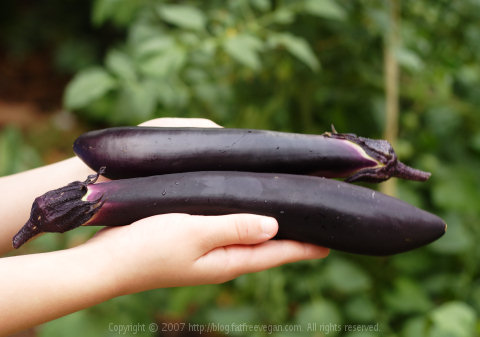
Over the weekend, we harvested the first of our Japanese eggplants, and I knew immediately what I wanted to do with them. Our favorite sushi restaurant used to have this eggplant appetizer that I loved until they slowly stopped serving it. I say “slowly” because at first it was unavailable every now and then, when the eggplants weren’t in season; then it was unavailable most of the time; finally, it disappeared from the menu altogether, and I was left craving this eggplant dish that I couldn’t get anywhere else.
What is it? It’s actually a very simple dish, a fact I found out after several more elaborate cooking attempts that never came out quite right. Japanese eggplants are broiled (or grilled, if you have the time), spread with a sweetened miso mixture, and then broiled again for a few seconds. The results are creamy, smoky eggplant with a sweet and salty sauce that will make you scream out “Yes Yes Yes!” But fortunately, you can keep from embarrassing yourself in public if you make it at home. (Oh, if only I’d known that sooner!)
You’ll notice that my recipe contains agave nectar, which is hardly a traditional Japanese ingredient. You can choose to substitute sugar, or you can try another natural sweetener, but you may need a little more because agave is sweeter than sugar and much sweeter than, for example, rice syrup or barley malt syrup. Stay away from maple syrup or any sweetener that’s strongly flavored, though; the sweetener’s just there to sweeten, not to deliver any flavor.

Nasu Dengaku (Japanese Eggplants Broiled with Miso)
Ingredients
- 2 tablespoons mirin
- 2 tablespoons sake (may substitute dry vermouth or white wine)
- 4 tablespoons mellow white miso (reduced sodium, if available)
- 3 tablespoons agave nectar
- 4 Japanese eggplants, stem end trimmed and cut in half lengthwise
- 1/2 teaspoon sesame oil (optional)
- toasted sesame seeds, for garnish
- sliced green onions, for garnish
Instructions
- Place the mirin and sake in a small saucepan and bring to a simmer over medium heat. Simmer for about 2 minutes to allow some of the alcohol to cook off. Then add the miso and stir until smooth. Stir in the agave nectar, reduce the heat to very low, and continue to cook, stirring occasionally, while you broil the eggplants:
- Brush the cut sides of the eggplants with the sesame oil, if desired. Put the eggplants cut-side down on a baking sheet and place under the broiler of your oven for about 3 minutes, checking often to make sure that they do not burn. Turn them over, and cook for another 3 minutes or until the tops are a light to medium brown. Do not burn! (If your eggplant still isn’t tender all the way through, try baking it–no broiler–a few more minutes; then proceed with the recipe.)
- When the eggplants are tender, top each one with the miso sauce and put them back under the broiler until the sauce bubbles up–this should take less than a minute, so watch them closely. Serve hot, sprinkled with toasted sesame seeds and green onions.
Preparation time: 5 minute(s) | Cooking time: 20 minute(s)
Number of servings (yield): 4
Nutrition Facts
Serves 4 as an appetizer. Per serving: 152 Calories (kcal); 2g Total Fat; (11% calories from fat); 4g Protein; 31g Carbohydrate; 0mg Cholesterol; 740mg Sodium; 5g Fiber.
Some Notes about Miso:
Look for white miso (which is actually more like beige in color) at your local natural foods store or in Asian grocery stores. You will find better prices in the Asian markets, but check labels carefully because many of the brands of miso there contain fish (bonito) extracts.
Though miso has many health benefits, it is very high in sodium, a fact that should be kept in mind by anyone following a low-sodium diet (and vegans may have added reasons to be concerned about sodium). Look for low-sodium miso and use it if available.


Anushruti
August 15, 2009 at 2:52 amThese look so delicious…love your creative ways to serve vegetarian fare.
Jasmine
April 18, 2010 at 8:02 pmgreat recipe! I didn’t have sake, so I subbed 1 tbsp of red wine vinegar. And I only used about 1 tbsp of sugar, and decided that was sweet enough for me. It needed extra oven time for me, and I let it broil a little longer with the topping on–until it got a little bubbly with a few blackened spots. It was delicious! Thanks so much!
Brion
July 24, 2010 at 7:04 pmA note on Miso paste — in the Japanese market, you can get either just plain Miso or what’s called “dashi-iri miso” which has the bonito dashi already mixed in for convenience. I like the dashi-iri miso for everything from traditional miso shiru soup to miso broils such as on mackerel. YUM!
Anyhow, look on the label for words “dashi-iri” or “with dashi” to discern from plain old Miso.
Also, there is bland plain miso, popular in Tokyo, and the darker red “akamiso” which is very robust and popular in western Japan such as Osaka and Nagoya. Enjoy!
Ruby
December 20, 2010 at 12:56 amNot to sound rude, but this is a vegan website so readers are trying to avoid dashi and bonito …
amber
June 25, 2012 at 4:28 pm“dashi” just means “stock” and can certainly be vegan
Susan Voisin
October 10, 2012 at 6:26 pmBut the dashi in miso is never vegan–or at least I’ve never seen a dashi miso that wasn’t made with fish.
kitty puller
January 8, 2011 at 4:27 pmlove the recipe.would be great if had a printable mode.I try and come in 10 pages.
SusanV
January 8, 2011 at 4:31 pmThere’s a link to the printer-friendly version under the title in the recipe. If you print it from there, it should print on one page.
lea
September 7, 2011 at 12:23 pmI made these last night and they are AMAZING! So yummy! I couldn’t find Japanese eggplants, so I used the standard large ones sliced into rounds. The toasted sesame seeds on top are a perfect compliment to the dish… sweet, salty, and nutty. I will definitely make this one again!
Manami
January 16, 2012 at 12:17 pmYou spelled wrong.
saki: wrong
sake: right
I believe that you spelled wrong because you pronounce the word “sa-key”.
The part “ke” in “sa-ke” should be pronounced such as the part “me” in the word “met”.
Although I was born and raised in Japan, I have never seen any Nasu Dengaku with white miso in Japan.
Dengaku usually use red miso or “awase miso”.
White miso is quite sweet, not so popular and usually used only in Kansai area.
Cara O'Sullivan
June 24, 2013 at 1:05 pmI want your cookbook someday for Christmas. I use your recipes for vegan eating more than any other website.
Richa
June 24, 2013 at 1:14 pmThe eggplant looks gorgeous!! I think this might change my mind abt eggplant as well
JOAN WL
June 24, 2013 at 2:19 pmThis looked appealing as I have always liked eggplant in restaurants but can’t seem to cook anything worth eating at home. I was surprised to see you use mirin. Once I read the label of available brands, I gave it a pass. Ingredients : corn syrup, salt. alcohol. Do you use a more acceptable brand? I now use rice vinegar and a bit of coconut sugar.
Susan Voisin
June 24, 2013 at 2:25 pmI use real mirin, not the kind in the grocery store, and it contains only rice wine, no sugar (corn syrup) or salt.
Brenda
July 8, 2013 at 5:36 pmWow Susan … this mirin/sake/miso sauce is the absolute best thing I have EVER tasted!! I thought if anything was going to let me enjoy eggplant, it was this recipe. I’ve yet to try an eggplant recipe that I like. But I got some small Japanese eggplants from our CSA, and made this recipe exactly as written. The eggplants were wonderfully tender, small, and …. sigh, all I tasted was eggplant.
I did lick the sauce off though!!!
Any suggestions as to other things this sauce might be good on??
Also, the sake and mirin should keep for a long time in the refrig, shouldn’t they?
Susan Voisin
July 8, 2013 at 5:56 pmSorry about the eggplant! I guess you really don’t like it! 🙂
I think the sauce is very good on baked tofu–add it near the end of baking and broil it a little. I haven’t tried it on other vegetables, such as zucchini, but I imagine it would be good.
Brenda
July 8, 2013 at 6:11 pmYea … I hope you don’t excommunicate me for not liking eggplant (grin!!). Great idea about using that sauce on tofu. All I could think of was coating soy curls with it (which might also work …. not sure …)
Anyway, thanks for a GREAT sauce recipe!!
Brenda
July 14, 2013 at 1:09 pmFollow up on the idea of using this sauce to make baked tofu:
RESOUNDING success!! Very tasty!! I pressed extra firm tofu between some towels to absorb the excess moisture, cut it into strips about an inch wide on each side, and covered all sides with this sauce.
Then I baked them at 400 degrees until the tofu strips were no longer moist at all, and in fact, slightly dried and “crinkly”.
Very good right out of the oven, but absolutely SUPERB cold, the next day!! I served them on top of a meal sized salad.
Susan Voisin
July 14, 2013 at 1:17 pmI’m so glad to hear that! Thanks for sharing your experience.
laura_veggiesecret
January 17, 2017 at 8:35 amThanks for your post. I made these, and it’s delicious. It was difficult I found Japanese eggplants.
Farida Banu
August 31, 2020 at 3:12 amHi! Susan Voisin. Really yummy recipe with clear steps.