Though a vegan can often be seen
Eating lentils and tofu and beans,
Still when omnivores pass
They invariably ask
“How do you get your protein?”*
Yesterday, Isa, the post-punk goddess of Vegan with a Vengeance, held a vegan limerick contest on her blog with the prize being a signed copy of her new book Veganomicon. I didn’t find out about it until just before it ended, and then I had a brain freeze and couldn’t think of anything to write. When I woke up this morning, the lines above just popped into my head, and perhaps they should have stayed there, but like a song that you can’t get out of your mind until you sing it out loud, I hoped that by posting my poor limerick here I could stop thinking in anapestic trimeter.
So what does this have to do with black bean pupusas? Not much, except for the fact that limericks are usually a little naughty and the word “pupusa” always sounds dirty, at least to my American ears. I actually tried to write a limerick about pupusas and got this far:
Intrigued a vegan cook named Susan….
No, “Susan” doesn’t really rhyme with “pupusa,” but it was as close as I could get without using “fuchsia,” which now that I think of it looks dirty, too. (You wouldn’t know it from reading this blog but I have a dirty mind and a potty mouth, especially when I trip over a toy or read the letters to the editor in our local newspaper. But I struggle mightily to keep this blog G-rated so that someday my daughter will read it and realize that my vocabulary at one time extended beyond “No you can’t have a cell phone” and “Who the **** left that skateboard in the hallway!”)
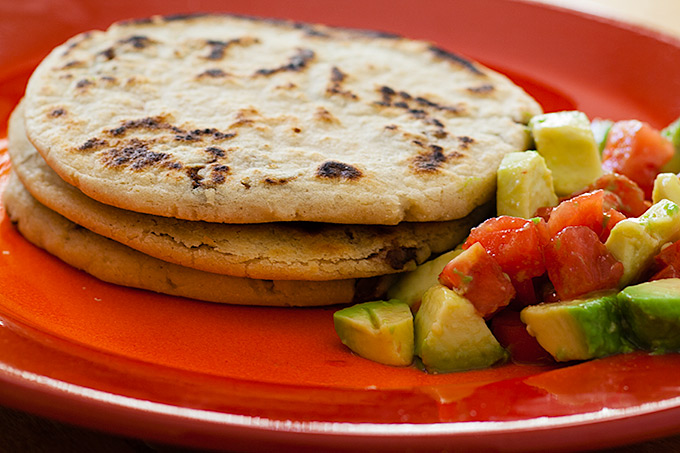
Anyway (and yes, there really is an anyway, though I’m tempted to write the bulk of today’s post in parentheses, just because), I’ve been interested in pupusas since the first time I saw them mentioned very casually on some vegan message board, as though everyone knew what they were. Since I’m not from El Salvador, where they originated, or California, where they are popular in some areas, I’ve never seen a pupusa, which as it turns out is simply a stuffed tortilla, sort of like a quesadilla, but with the filling completely enclosed. I’ve been meaning to make them for months, and I finally got a chance last night.

I adapted this recipe from Myra Kornfeld’s The Healthy Hedonist, and I have to say that I can’t recommend the recipe as it’s written in that book. It called for 5 cups of masa harina and 2 1/2 cups water, but that is way too little water for the amount of masa flour. I had to add more water just to get the mixture to form a dough, and later, when I checked a few recipes online, I realized that they all used even more water than I had.
The recipe also called for using warm water and kneading the dough for 2 minutes, and since none of the other recipes I’ve looked at do those things, I can’t say for sure whether they are necessary or not. Next time I might try another recipe for the dough, such as this one, just to see how it comes out, though I do prefer the following technique for forming the pupusas.
Despite the difficulty figuring out how much water to use, I think the pupusas came out great, especially after I got the hang of forming them and patting them out thin enough. The black bean filling was really delicious, though I didn’t have quite enough to fill all the pupusas, so I had to make one plain, unfilled tortilla. Next time, I plan to fill some of them with “cheeze” in addition to black beans.

Black Bean Pupusas
Ingredients
Filling:
- 1/2 medium onion minced
- 2 cloves garlic minced
- 1 15-ounce can black beans (1 1/2 cups), rinsed and drained
- 1/2 cup vegetable broth
- 1/2 teaspoon cumin
- 1/2 teaspoon smoked Spanish paprika
- 1/2 teaspoon oregano
- freshly ground pepper to taste
- 1 teaspoon fresh lime juice
Tortillas:
- 5 cups masa harina (I used Maseca brand)
- 3 1/2-4 cups warm water
Instructions
- Sauté the onion in a non-stick saucepan until softened and add garlic. Cook for one minute more. Add the remaining filling ingredients, except the lime juice, and cook for about 5 minutes, until hot. Using a potato masher, mash the beans until they are creamy. Simmer uncovered, stirring often, until most of the liquid is absorbed, about 5 minutes. Remove from heat and stir in the lime juice. Set aside to cool as you make the dough.
- Put the masa harina into a large bowl or into the bowl of a stand mixer. Add 3 cups of water and stir. Add more water until the mixture clings together and forms a dough. It should be soft and pliable and not crack when you press on it. Knead the dough for about 2 minutes (1 in a mixer fitted with a dough hook).
- Divide the dough in half and return half to the mixing bowl, covering it with plastic wrap. (If you like, you can refrigerate half the dough to use later, as I did.) Take the other half of the dough and divide it into 9 equal pieces. Cover 8 of the pieces with plastic wrap or a damp cloth while you work on one piece.
- Form the piece of dough into a ball, and place it in the palm of your hand. Use your fingers to make a hole in the dough and work it until you form a cup that has walls that are about 1/4-inch thick.

- Add about 1 to 1 1/2 tablespoons of beans to the “bowl,” enough to cover the bottom but leave at least 1/2-inch clean at the top.

- Pinch the sides together, leaving a little extra “nub” at the top.

- Pinch off the little nub of dough, sealing the top, and return the piece of dough to the bowl (you can gather all the pieces at the end to make another pupusa).
- Now’s the tricky part. Gently but firmly press on the dough to flatten it out. Try putting it in your left hand and pressing down on it with your right as your right thumb also compresses it from the side. When it’s flat, put it down on a cutting board and use your hands to flatten it even more, until it’s between 1/4 and 1/2-inch thick and about 4-5 inches in diameter. Take care not to squeeze the filling out, and repair any small tears by pinching them closed (or even take a bit of dough to make larger repairs.)
- You can make all the pupusas this way and then heat your griddle and cook them all, or you may cook each one as you make it. (I prefer to make a couple, get them started on the stove, and continue shaping pupusas as the first two cook–it seems to be quicker this way.)
- Heat a cast iron griddle or skillet over medium-high heat. Cook the pupusas until brown spots appear on the bottom and the tortilla appears dry, about 3-4 minutes. Then turn over and cook until the other side is browned. Keep them warm in the oven until all of them are cooked. Serve hot.


Nutritional info is approximate.

I served these in two different ways. The first time I made a coleslaw recipe similar to the traditional Salvadorian pupusa accompaniment, curtido. Unfortunately, it was all eaten up before I took photos, so the second time I served them, I made an impromptu avocado salad (avocado, tomato, salt, pepper, lime juice, chipotle chili powder). I liked both the coleslaw and the avocado salad, but I’d have to say that D and I preferred the pupusas topped with the salad, along with some spicy salsa.
*PS–The answer to “How do you get your protein?” is “From FOOD!”
Please Pin and share!

andrea
i love you! anytime i want a vegan recipe you have it! and this one corroborates my black bean pupusa ideas! yay ~now for our vegan bbq! (it's the roasted peppers and corn on the cob that MAKE it!)
Vera
I have been looking all over for a pupusa recipe…I think I finally did. Thanks, Susan!
suz
Congrats on the move to wordpress! I thought of this recipe after finding Maseca for the very first time. I made these with a friend and it was the perfect way to spend a lazy Saturday
Manny
dont take this the wrong way. Leave it to a white gril to turn anything into healthy food. Pupusas are usually FAT to put it nicely, I like the salad touch rather than the salvadorean coleslaw. I will definitely try it. nice touch
Gaard
Hello, I’m salvadorean and I’ve happened to stumble upon your pupusa recipe, it is cool to see anyone who isn’t salvadorean or latin american interested in pupusas at all.
I realize this is a vegan thread but just to expand your list of ingredients here in El Salvador they are prepared with a leaf of “mora” (I have no idea on how it translates) and “ayote” (wich is a sort of squash that is boiled and put inside) some people put potato in it but that is one of the least popular options, usually pupusas are accompanied with cheese (this cheese is called “quesillo”… wich resembles mozzarella but is a bit more stretchy I guess) but I think you can also skip it.
Pupusas in most dining places are really greasy because of the cheese and the lot of oil people use to cook them but in some traditional parts they are cooked in a “comal” (a flat griddle made of cast iron or “barro” -pottery-) with barely enough oil so the griddle as well as the food don’t burn.
Since you are trying to cook with as little fat as possible I’d recommend you use olive or canola oil (wich is more common use here) to put an even coat on the whatever you’re cooking it in; you can skip the oil completely but the dough won’t get the usual hydration from the oil (and the cheese) and may have a bit of a dry result tasting more like a thick tortilla on the places the filling can’t reach such as the edges wich I guess can be overcome with the flavor of the curtido and salsa.
Those are one of the more “standard” fillings for the pupusas, but in some places you can find them filled even with shrimp or beef or, chicken or well, pretty much anything.. so the filling is pretty much up to you; I guess you can always experiment with fillings as long as you feel satisfyed with the resulting taste..
Semi-on topic: Pupusa -apart from the food- is actually also a slang-term in our society and has a dirty connotation (I don’t know wether you know about it or just have the general idea of what it means) but I won’t repeat the meaning in this blog for the sanity of you and your readers, since I happen to be a well-mannered lady 🙂
EmmeG
Ah, pupusa! I love the version that mixes masa rica with rice flour best – those are the crispiest, yummiest kind of pupusas. Can’t remember what they are called right now though!
“Mora” leaf, as mentioned by Gaard in the above comment, is blackberry/bramble leaf.
Gloria
Pupusas! Everywhere you turn, you see Pupuserias in Los Angeles, where I moved to in 2002. They are akin to the Mexican Gorditas, except gorditas are fried and served split open and stuffed.
The typical peasant food is usually the healthiest, and that is what pupusas are – the food of the poor, most commonly filled with cheese, but the good thing about them is you can fill them with anything healthy that is imaginable (shredded zucchini, corn, any kind of bean puree, spinach, purlane, chard, potatoes, sweet potatoes, yam, the list goes on and on. Love it!
Cindy Stromberg
Hi Susan! I live in Honduras close to the border of El Salvador where pupusas are abundant! It’s my family’s Friday night treat each week. Just wanted to say that for someone who hasn’t seen a pupusa before, the ones in your picture look exactly like what we eat in the pupuseria each week! Great job!! Someday I will actually try to make them (the ones we buy are pretty greasy, but delicious!)
Kady
This is so timely! I just moved to central america and all the pupusas have cheese 🙁 but this is perfect!
Meridith
We made these the other night and my 2 year old daughter has officially named them bean pancakes. 🙂 The whole house loved them!
lovemyfamily
well, I think it takes someone much more talented than me to make these. I gave up trying to keep the bean inside the maseca. I probably won’t make them again unless someone is visiting me that grew up making these and I can get a tutorial. The flavor was good, but we all love almost any kind of bread.
Marcela
I am from El Salvador and came over from tastespotting. I think your pupusas look delicious.
My very favorite ones are the ones made with squash.
Great post. Beautiful reminder of my great culture.
SusanV
Thanks so much, Marcela! I hadn’t known that squash was used as a pupusa filling, but now you’ve got me curious. I can’t wait to give that a try.
Tracy
Great step-by-step photos of how to form the pupusa. That is exactly right. I’m surprised you got such nicely shaped ones – it isn’t easy!
My Salvadoran mother-in-law sometimes makes just bean ones but I don’t like them. I must have cheese, and I like them greasy! I know this is a health blog, but I’m just being honest! … I found my way here through my friend Marcela up above 🙂
It’s hilarious that you instinctively felt pupusa might be a dirty word. As Gaard pointed out here in comments – it is used as a slang term in El Salvador. I will go a little further than he did, and tell you that it’s used to describe the female anatomy.
Happy pupusa eating… LOL. (Now that doesn’t sound right.)
SusanV
Oh, now I’m LOL! Thanks for verifying my hunch about the word. I do think that cheese (a vegan cheese in my case) would be incredible in pupusas. I need to make them again soon!
sonya
how do i make the coleslaw “curtido” that goes with it?
Jorge
Hello Sonia,
this is one recipe (of many); if you want the “curtido” spicy, you can add some chili peppers -jalapeños, serranos, or just any hot peppers.
Curtido Salvadoreño
1 medium head cabbage, chopped
2 small carrots, grated
1 small onion, sliced
1/2 teaspoon dried red pepper (optional)
1/2 teaspoon oregano
1 teaspoon olive oil
1 teaspoon salt
1 teaspoon brown sugar
1/4 cup vinegar
1/2 cup water
Directions
1. Blanch the cabbage with boiling water for 1 minute. Discard the water.
2. Place the cabbage in a large bowl and add grated carrots, sliced onion, red pepper, oregano, olive oil, salt, brown sugar, vinegar, and water.
3. Place in the refrigerator for at least 2 hours before serving (the longer the better).
Enjoy.
-jc.
Jorge
Hello,
I am Salvadorean and vegan; perhaps one of the few around -ha!
I make my pupusas with Daiya or Teese cheese with red beans (Salvadorean beans) or black beans. They are delicious!
You must try them with vegan cheeses alone… what a treat!
Also the squash one are very taste too; I prefer beans or vegan cheese. I have made them with squash, cheese, spinach and grilled onions and beans.
Be creative and try new fillings and let us know. The spinach ones could be tricky, you must drain all the spinach liquid for them to work, but if you do them right they are so freaking good!
Thanks for sharing this vegan recipe to the world!
-jc.
Jessica
It’s so nice to see other vegan Salvadoreans! Though I was not born in El Salvador, both my parents are from El Salvador and my mom always make vegan pupusas on a separate plate for me 😀 we also use Daiya! Lol
I know your comment is quite old but I just felt like pointed it out 🙂 I also love the squash ones!! I also like them filled with white beans 🙂
Jorge
Hola Jessica!
Like you said, it is nice to know there is more than “one” vegan Salvadoreans!
Kudos to your mom for the support and making vegan pupusas for you, next time ask her to make some of Soy Chorizo and/or any vegan sausage, just break it apart. You can do some “revueltas,” of beans, Daiya and sausage, they are delicious.
I made some for my brother and sister who are not vegan and they loved them. Of course you gotta have curtido with them.
Take care,
Jorge.
Angela W
Hi Susan.
I just got around to making these and they were super. I made your avocado salad to top them –yum! I alo made the salad recommended by Jorge in your comments section–so good! I feel as though I’ve just eaten a restaurant-quality meal. Thanks!
Betty McEnaney
You made me laugh out loud….I never, ever would have guessed the potty mouth part. It took me half a second to fill in the blank about the skate board…loved the humor, and can’t wait to try this! Thanks for all you do.
Tamara
These look great! I make arepas every week, and these are basically arepas stuffed with beans. I can’t wait to try this over the weekend. I finally bought an arepa maker, and they turn out perfectly every time without standing over the stove cooking each one. Then I refrigerate them and pop in the microwave for breakfast or lunch at work.
Mary
Your limrick is better than the others on the punk vegan site that I saw. The only change I would make is “How is it you get your protein?” to make it closer to the right amount of syllables. Thank you for the papusa recipe. I had them at a party last night and found them to be delicious. I was hoping I could find a recipe today.
Cindy
2013 and I’m just seeing this! I live in Costa Rica and pupusas are popular here. I must say that yours look every bit as good as the ones that people make all the time! I’m going to give it a go! Love you site and everything I’ve tried is amazing!
Esther J
I stumbled across this recipe while looking at another and was so elated to find that you have a pupusa recipe (of course you have one)! It’s been *years* since I’ve had these! I made it as is and also used Jorge’s curtido recipe for that nice touch. Was pretty good, even if they weren’t as pretty as yours! Next time I might punch up the spices a bit, but without “cheeze” was fine with me.
Thanks, Susan. 🙂
Joy
Thank you for this recipe! I was a missionary in Costa Rica almost 20 years ago. One of my companions was from El Salvador and she taught me to make these. But I completely forgot about them until now. I can’t wait to taste them again.
Katie S.
I love pupusas but have been limited to the ones by Tres Pupusas that are sold at Whole Foods (the vegan one anyway). I can’t wait to experiment with my own flavors and vegan cheeses. Thanks, Susan!
Brittany
I haven’t found a single good vegan cheese. Which brands do you use?
Brittany
These sound amazing! I recently made a huge pot of red beans. Do you think they would work well with this recipe?
Susan Voisin
Sure! Any beans will do, and freshly cooked beans are even better.
Rosa
Yo soy Salvadoreña y también soy vegetariana. Yo uso un poquito de aceite antes de hecharlas al comal. Me quedaron ricas. Buena receta.