I’m always saying that I love Korean food, but when I stop to think about it, what I really love is certain flavors of Korean food: kim chee, Korean barbecue sauce, and gochujang, the hot pepper paste that Koreans consider one of their three essential condiments. I’m sure there’s more to love about Korean food, but because I’m a vegan, I’ve never tasted most of it. Korean restaurants in the US have menus that center around meat and fish dishes, and whenever I’ve eaten at one, I’ve had to ask that dishes be prepared vegetarian. Fortunately, the chefs have been very accommodating, letting me know which meals can and can’t be prepared vegan, but a lot of the food is off-limits.
Since I now live in a state with no Korean restaurants at all, when I’m craving Korean food, I have to make it myself. Bi bim bab is one of my family’s favorite dishes, but making it the way we like it takes a lot of time: 4 or 5 separate dishes must be prepared, as well as rice and a sauce made of gochujang. It’s a lot to go through when what you really love most is the spicy-sweet-sour, unique, taste of gochujang. So to satisfy my cravings for that flavor, I’ve started using gochujang in other, non-traditional, dishes, such as this quick noodle stir-fry for two.
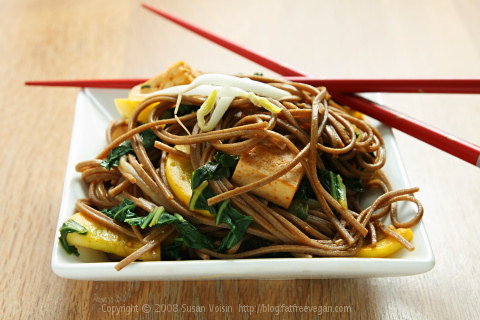
Korean Noodle Stir-fry
To my taste, this dish is fairly mild, so if you want more spiciness, be sure to have some extra gochujang available to add to taste at the table.
Ingredients
- 4 ounces buckwheat soba (one bundle, broken in half)
- 8 ounces firm tofu, cut into bite-sized cubes
- 1 tablespoon low-sodium soy sauce mixed with 2 tablespoons water
- 1/8 teaspoon sesame oil
- 2 medium yellow squash, halved lengthwise and sliced 1/8-inch thick
- 1/2 onion, cut into thin wedges
- 4 cups bok choy (3-4 baby bok choys), sliced thin
- 1 teaspoon garlic, minced
- 1 cup mung bean sprouts
- 1 1/2 tablespoons gochujang
- 3 tablespoons water
- 1/2 teaspoon sugar or agave nectar
- 1/8 teaspoon sesame oil
Instructions
- Put a large pot of water on to boil. Add the soba and cook according to package directions. Drain and rinse briefly with cold water. Set aside.
- While the pasta is cooking, prepare the tofu and vegetables. Spray a large non-stick skillet or wok lightly with oil and heat it over a medium-high burner. Once it’s hot, add the tofu in a single layer. Cook until light brown on the bottom, and add the soy sauce/water mixture and the 1/8 teaspoon sesame oil. Turn the tofu cubes over and cook until liquid has boiled off. Remove from the pan and set aside.
- Add the squash and onion to the skillet and stir-fry until the squash is just beginning to get tender. Add the bok choy, garlic, and 2 tablespoons of water, stir well, and cover. Cook until bok choy is wilted but still bright green, just a couple of minutes. Add the bean sprouts and cook, covered, one more minute.
- In a small bowl, mix the gochujang, water, sugar, and sesame oil. Add it to the vegetables and stir well to coat.
- Add the tofu and pasta to the vegetables, and toss well to distribute evenly. Cook until heated through.
- Serve with additional gochujang, which can be thinned with water and a splash of sesame oil.
Preparation time: 15 minute(s) | Cooking time: 20 minute(s)
Number of servings (yield): 2
Makes 2 large servings. Per serving: 386 Calories (kcal); 9g Total Fat; (18% calories from fat); 26g Protein; 59g Carbohydrate; 0mg Cholesterol; 1372mg Sodium; 6g Fiber. 8 Weight Watchers points.
About the Ingredients
You can find gochujang (which is also spelled kochuchang and gochuchang) at Asian grocery stores that sell Korean products. If you can’t find it yourself, be sure to ask. Sometimes it’s even better to bring in an empty package or a photo:

It comes in jars or tubs that are often labeled “Hot Pepper Paste.” Unlike other “chili pastes” that you may find, it’s a thick paste with the consistency of miso and a uniform color of dark red. Once opened, it will keep in the refrigerator for a very long time.
You can use any noodles you like for this recipe, but I like buckwheat soba:

One bundle of noodles is enough for two servings. I like to break them in half for this dish; otherwise, it’s hard to distribute the vegetables throughout the pasta.
I hope you’ll look for gochujang the next time you’re out shopping. If you like spicy food, you really owe it to yourself to give it a try.
Siddhi Sheth
Hello Susan,
This website is amazing. I am so excited about your Korean noodle stir-fry recipe. I am making it tommorrow with my friend and will be posting the results on my blog (siddhivegcook.blogspot.com).
-Siddhi
Hyosun Ro
Wow, your noodle recipe looks really good. I am a Korean-American mom of two grown-up children, and have recently started a food blog to post the recipes for Korean food that I have been cooking all my adult life. It all started with my kids who are now away from home wanting to cook Korean food that they grew up with. Many of their friends are also big fans of Korean food and my blog, and some of them are interested in vegan or vegetarian dishes. So I am trying to consider such options in my recipes. Recently I posted a Japchae recipe that are a vegetarian dish you might like to check out. If you try, I would love to hear your feedback. Here it is: http://eatingandliving.blogspot.com
VEG-DELI
I always would like to cook Vegetarian Korean dishes without garlic, onion, onion springs and shallots. It's not easy to find though. I visited a few Korean Vegetarian and Vegan restaurants in a few states in South Korea. There were a few restaurants which I enjoyed my meal there. I did try the Japchae at one of the restaurants too.. They really taste great.
Katie
Mmmm!! Looks delicious!! I will try making this. Japchae is another dish that can be done vegan very easily. The flavours are very similar to what you’ve done here.
Dan
Susan, Thanks for posting this recipe. I am not a fan of the gochujang, can I just omit it? Or, if you can think of a substitute, please advise. Not a spicy food fan, but all the rest looks terrific! Thanks!
Susan Voisin
Hi Dan, you can omit it completely if you don’t like spicy food or substitute it with some sauce that you do like. Feel free to adapt it to your tastes.
Annette Greene
I eat a lot of Asian food and also try to eat gluten-free as much as possible. I was surprised to learn recently that, although buckwheat flour has no gluten, many brands of buckwheat noodles (but not all) are made with a combination wheat flour and buckwheat flour. You need to read the labels carefully. Thanks for the stir-fry recipe, Susan. It looks delicious!
in shower
Hmm it looks like your blog ate my first comment (it was extremely long) so I guess I’ll just sum it up what I submitted and say, I’m thoroughly enjoying your blog. I too am an aspiring blog writer but I’m still new to the whole thing. Do you have any helpful hints for first-time blog writers? I’d really appreciate it.
Kim
Hi Susan! You know me , I’m a fan of all your food ! I saw this in my FB feed this morning and noted grocery items to have once more. Love me some Korean food. Serving with Kimchi . For ‘dessert, maybe a mango Or Korean melon ( chamoe )